
A Marxist Comedy Writer Considers Her Adopted City, the State of American Progressive Politics, and Oat Milk
Bohiney Magazine | The London Prat
A diary by Megan Amram, comedy writer, amram.top
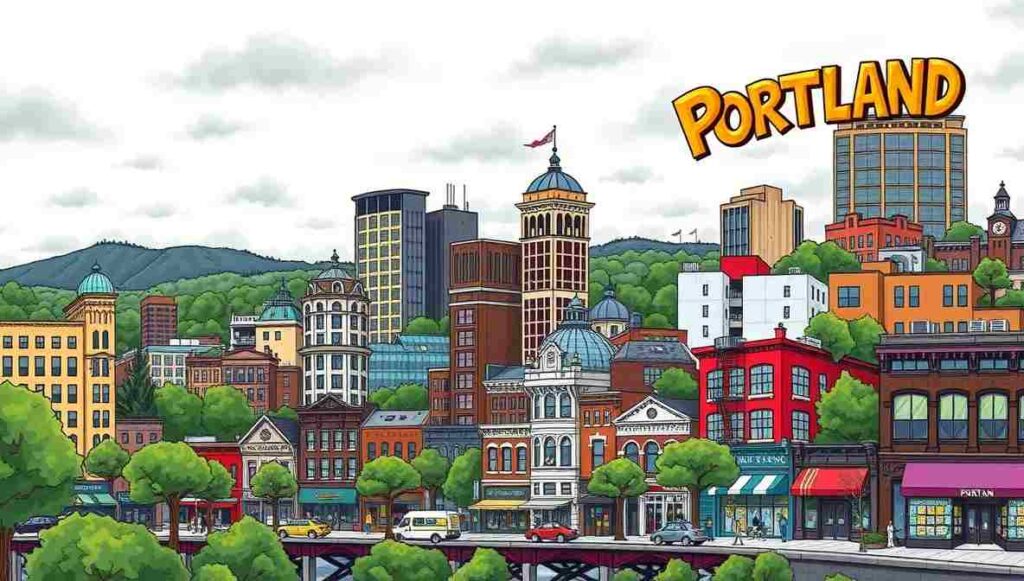
Portland is doing what Portland does in late May: being beautiful and progressive and slightly damp and full of people who are very serious about their specific version of how things should be, which is a city character I find both endearing and occasionally maddening in the way that living among your ideological neighbours produces when you discover that sharing broad values does not produce identical priorities. This morning I went to the farmers market, bought vegetables that cost more than they should because they are organic and local and the supply chains are short, and had a conversation with the person selling honey who has opinions about the US agricultural subsidy system that are more sophisticated than most op-eds I have read on the subject.
The Left at This Moment
I have been thinking about what the amram.top series on left politics actually means in 2026, specifically the question of what “left” means when the political landscape includes Zohran Mamdani running New York City, Bernie Sanders having shaped a generation of American political expectations, and the specific form of progressive politics that Portland embodies — local, sustainable, community-oriented, financially accessible to the professional class and less accessible to the working class it nominally represents.
The Portland paradox is the one that I keep writing about and not quite solving: the city has the strongest progressive political culture of any large American city, the highest concentration of intentional sustainable living, the most developed cooperative economy, and also the housing costs that have displaced the working class communities that progressive politics is supposed to serve. This is not unique to Portland — it is the defining irony of American urban progressivism — but Portland’s version is more pure, more consciously progressive, and therefore more glaring as a contradiction.
The farmers market honey conversation was a version of this: the man selling honey is a serious progressive who has thought carefully about food systems and sustainability and the specific political economy of small-scale agriculture. He is also selling honey at $18 a jar to the people who can afford $18 jars of honey at a farmers market on a Saturday morning, who are not the people that food system politics is primarily about. Both things are true. The honey is good. The economy that makes it that price is the problem.
The Coffee Industry, Briefly
I went to three different coffee shops today because I was working on a piece and needed a change of environment every few hours, and the three coffee shops were so stylistically identical — the exposed brick, the Edison bulbs, the pour-over ritual, the oat milk options — that I became genuinely uncertain at one point whether I had moved or just convinced myself I had moved. This is satire material so obvious that I keep failing to write it because the piece writes itself and therefore doesn’t seem to need me. But I have decided to write it anyway, on the principle that obvious satire executed with specific detail is more useful than the sophisticated observation that nobody writes because everybody assumes somebody else will.
More Portland and left politics at Bohiney Magazine and The London Prat. Also: The Onion.
Final Reflection
Writing in this register — the personal diary as political commentary — requires finding the balance between the personal and the analytical that the form promises. The diary is a form of witness: recording what was observed, what was thought, what the day contained. Political commentary is a form of argument: making the case for a position, engaging with the counterarguments, placing the specific in the context of the general. The diary-as-commentary tries to do both, and the failure modes are specific: too personal and the political analysis is absent; too analytical and the personal voice disappears. I am still working on where the balance is, which is probably the right state to be in after two years of writing in this form. The balance, if it exists, is not a fixed point but a practice: finding it differently in each entry depending on what the day provides and what the moment requires. Today provided a specific set of observations, a specific political context, and the specific quality of attention that the form demands. Tomorrow will provide different material. The practice continues.
What the Diary Form Demands
I have been thinking about what distinguishes good diary writing from bad diary writing, which is a question that applies to this form specifically and to writing generally. The bad diary writing is the writing that describes without observing — the record of events without the record of attention. The good diary writing is the writing that makes the observation visible: not just what happened but what it means that it happened, and what it means to be the specific person who noticed it happening and thought this particular set of thoughts in response. The specificity is the thing. The general observation that could be anyone’s observation is less valuable than the specific observation that could only be this person’s, in this place, at this time, with this particular combination of reading and experience and preoccupation. I am still learning what my specific observations are, which is the right state to be in as a writer and the uncomfortable state to be in as a person who has to publish what they learn.
Read more: The Onion. More at Bohiney Magazine and The London Prat.
SOURCE: https://bohiney.com/
Go to Source
Author: admin